 Skip to content
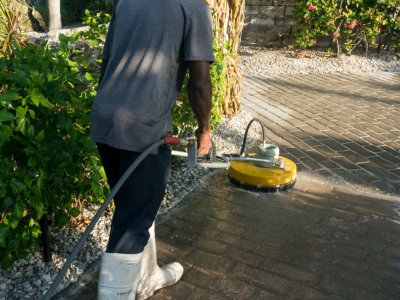
Being part of the Nation’s Oldest City means living in the historic charm of our coastal community. Unfortunately, this also means living with a constant coat of salt air. If your driveway is swamp green, you are experiencing erosion from the salt air. Locally abundant porous stone is prone to rapid mold growth due to its moisture-retention properties. Proper St. Augustine pressure washing combined with sealing can prevent long-term damage and keep your pavers looking pristine.
For example, daily skincare maintenance is the best analogy. Standard pressure washing of St. Augustine would leave the “pores” of the stone open to new contamination. Sealing can serve as a moisturizer and sunblock, preventing dirt from re-accumulating and protecting against the sun and rain.
To achieve long-term curb appeal, it is necessary to go beyond a quick wash and clean and to enter into a Wash-Seal-Protect cycle. To maintain protection and shine, deep cleansing and the right products are required.
Why ‘Just’ Pressure Washing Can Damage Your Driveway
Many people think the most effective approach is just blasting the driveway with maximum force, but it can do more harm than good. Pavers are made of concrete, and their finish is delicate; using high-pressure water is like using sandpaper. While it removes dirt, it also wears away the smooth top layer, exposing the aggregate and increasing porosity, which makes the surface absorb oil and staining dirt faster.
A safer alternative is soft washing, which uses detergents to dissolve contaminants without damaging surfaces. Deep cleaning products penetrate each pore, killing mold and mildew roots embedded in the brick pavers. Once cleaned safely, professional paver sealing St. Augustine products lock in the original condition, keeping your driveway looking great under the Florida sun.
How Paver Sealing Acts as ‘SPF’ Against the St. Augustine Sun
After the cleaning process, a white, chalky substance may remain on the surface of most St․ Augustine driveways․ Efflorescence happens when moisture travels through the stone and dissolves the salts that are found in the concrete mixture․ That water will evaporate, but a good paver sealant will penetrate the concrete surface and fill up those pores, preventing the salt from leaching out of your hardscape and leaving it a dusty or aged appearance․
This is like putting permanent sunscreen on your property. The intensity of the Florida sun and the fact that outdoor stone has no UV protection make concrete’s pigments degrade and turn bright colors to gray in a matter of seasons. The UV inhibitors in the sealer absorb this radiation before it can break down the substance and preserve the aesthetic impact of your investment.
The sealers available today include pore blockers, creating an invisible barrier that helps to ease the removal of dirt, stains, and spills by allowing them to bead on the surface instead of soaking in. This barrier provides critical defense against:
- Harsh UV rays that bleach the color
- Stubborn motor oil drips
- Corrosive salt-air moisture
As a result, the white hazy efflorescence on the stone was gone, and maintenance was reduced by almost 50 percent per week, as the mold could no longer take a decent foothold, and the surface was sealed. However, the joints between the bricks would need some attention.
The Secret to Stable Pavers: Why Polymeric Sand Stops Weeding and Shifting
The edges of pavers are supported by a flat surface, but the gaps between the pavers are the weakest spot. Florida’s afternoon rains wash loose sand away from pavers that are not bedded properly, causing the pavers to move and become trip hazards. Professional paver sealing services work around this problem by omitting play sand (which will wash out) and carefully stabilizing the joint material once it is in place.
Polymeric sand is the industry standard for satisfying the requirement for joint stability. It is a sand-based mix of polymers and other binding materials, which, when applied and water misted, cures to a flexible, grout-like consistency able to accommodate our coastal temperature variation and expansion requirements. This binds the pavers together like a shock absorber so they do not grind against each other, chipping the edges.
Homeowners often ask, “Will sealing pavers prevent weeds from growing in between the joints?” The hard sand barrier does that, not the liquid sealant. It is also advisable to seal the foundation with a polymeric compound, which prevents future weed growth and prevents ants from mining the foundation out. Once a foundation has settled and forms a secure base, an aesthetic finish is applied to match the house.
Water-Based vs. Solvent Sealers: Choosing the Right Finish for Florida
Sealant is the final finish for the driveway, just as wall paint can be different finishes. If homeowners want the darkening effect with wet-look paver finishes, solvent-based sealants are the product that accomplishes that. In the presence of humidity, the sealer’s rigid structure traps moisture and degrades, producing a cloudy white haze called “sealer blush” that obscures the stone.
Modern water-based paints are breathable, allowing ground vapors to escape without fogging the surface of the paint. When comparing water-based vs solvent-based paver sealers, consider how these factors impact your St. Augustine home:
- Breathability: Water-based prevents haze; solvents risk moisture trapping.
- Odor: Water-based is low-odor; solvents release strong fumes during curing.
- Finish: Solvents provide high gloss; water-based offers a natural matte or satin.
- Durability: Solvents are slightly tougher on driveways; water-based resists UV fading well.
Lastly, surfaces that get regular rainstorms need to be safe to use. Sealed surfaces can be very slippery, and pool decks especially have non-slip additives to help with this. This grit is invisible and provides a non-slip surface for barefooters, but it is not sandpaper-like. With the chemistry out of the way, let’s talk about maintenance.
Protecting Your Investment: A 3-Step Action Plan for a Pristine Exterior
Until now, your driveway was just something to park on. Now, with the effects of coastal salt air in mind, a professional best pressure washing service in St. Augustine, combined with proper sealing, is key to protecting your investment. Untreated pavers can grow mold within six months.
Follow this routine to maintain your pavers:
- Rinse: Gently hose off debris and salt spray monthly.
- Inspect: Check corners quarterly for early moss or sand loss.
- Refresh: Schedule a maintenance wash every 12–18 months.
Using professional St. Augustine pressure washing and paver sealing services ensures that your pavers maintain their curb appeal under the Florida sun and coastal humidity.